We surround ourselves with paper everywhere and in many forms, from books and newspapers to tea bags and pizza boxes. It is simply difficult to imagine life without it. At the same time, there are many myths about paper and print, especially regarding environmental impact and sustainability. But which claims are actually true? We are going to find out now – come along!
Myth 1: Paper is an environmental villain
One of the most persistent myths about paper is that it is not very environmentally friendly. But the fact is that paper is made from wood – a one hundred percent renewable and natural raw material. When trees grow, they absorb and store CO2, thereby reducing the impact of climate change.
Ask us, and paper is therefore one of the most environmentally friendly materials we have – as long as it is made from raw materials from sustainable forestry and produced with strict environmental requirements. But how can you as a consumer know that, you might ask?
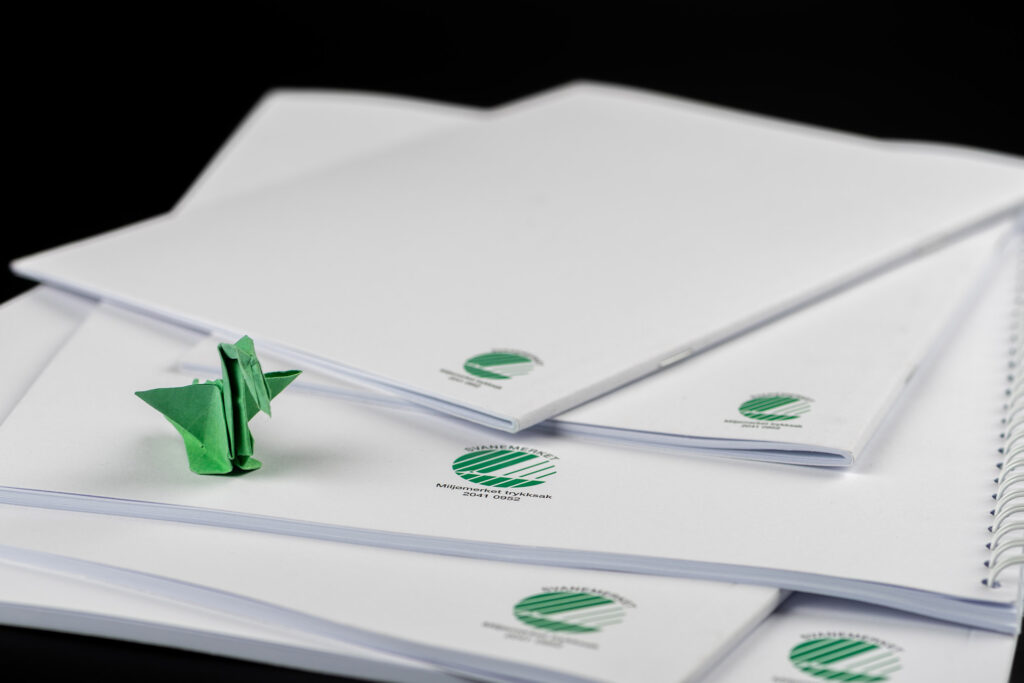
Fortunately, there are several recognised forestry certification schemes, the two best known being FSC and PEFC. You can also look for the Nordic eco-label, Nordic Swan Ecolabel.
The most important thing of all is, in any case, not to use more paper than you need.
Myth 2: The paper industry contributes to deforestation

Contrary to popular belief, European forests are growing rapidly – by as many as 1,500 football pitches a day. In Norway, for example, we have three times as much forest today as we did a hundred years ago!
Unfortunately, paper production in certain countries – such as Indonesia and Brazil – is still linked to deforestation. However, the paper we use in Norway is largely made from European timber.
Myth 3: Too little paper is recycled
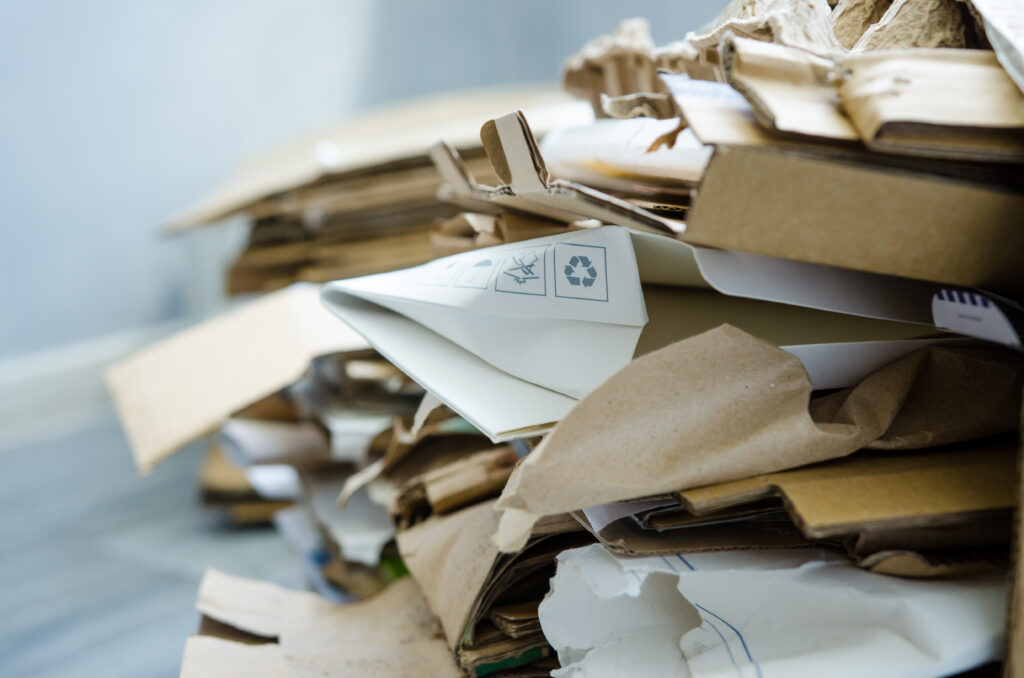
Paper fibres can be reused up to seven times, which is why paper is perfect for recycling! However, not everyone is aware of how much paper is actually recycled. In Europe, the recycling rate is 74 per cent, and for paper packaging it is even higher.
For every tonne of paper we recycle, we save up to 14 trees. In addition, we save energy, as it takes much less energy to produce new paper from recycled fibre. That is smart resource use!
Myth 4: Paper production leads to major greenhouse gas emissions
All paper production requires energy, but the paper and print sector accounts for only 0.8 per cent of greenhouse gas emissions in Europe, according to the European Environment Agency. In addition, the industry works continuously to find more energy-efficient production methods. It is also worth mentioning that 62 per cent of primary energy consumption comes from renewable sources.
Myth 5: Digital communication is more environmentally friendly than paper
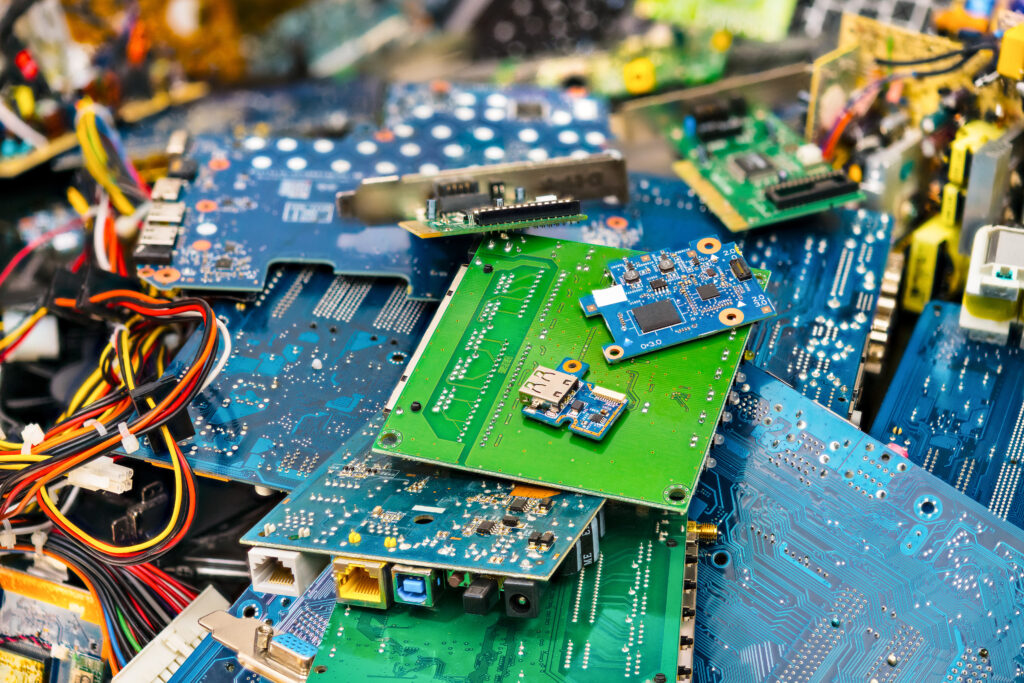
We often hear that digitalisation leads to less paper, which is good for the environment. There is less talk about the fact that data requires energy – in fact, the tech industry currently accounts for around three per cent of global greenhouse gas emissions.
In addition, the mountains of electronic waste are growing. A study carried out by the Global E-waste Monitor (GEM) 2020 showed that a massive 53.6 million tonnes of electronics were thrown away in 2019! Of this, as little as 17 per cent was recycled. This is not only a waste of resources, but is also a threat to nature and humans because electronics often contain toxic chemicals.
In short…
Paper is one of the most environmentally friendly materials we have – but we all have a responsibility to use it sparingly, recycle it and ensure that the paper is made from timber from sustainable forestry.
Need help finding your way through the sustainability jungle? We are a Nordic Swan Ecolabelled printing house and know how to make an eco-friendly choice – just get in touch!
Sources: nordics.twosides.info, norskgjenvinning.no, theguardian.com, sortere.no, tryktinorge.no, capgemini.com, NHO, sirkula.no